
Our Panel Overview
Our panel comprises 10M+ unique IP addresses and millions of AI conversations collected through voluntary opt-in across ChatGPT, Google Gemini, and Anthropic Claude. For transparency, we share the demographic and behavioral characteristics of that panel here so you can judge what our conversation data represents and how it was gathered.
We collect millions of ChatGPT, Gemini, and Claude conversations across a panel of 10M+ unique IPs, and we believe in transparency about our data sources. The panel-size figure is current as of September 27, 2026. The demographic, geographic, language, intent, industry, device, and model-mix percentages below remain the Q1 2026 snapshot, with prior baselines going back to late 2024. This page describes the key demographic characteristics of our conversation panel, so you understand what our insights and analysis are based on.
How We Collect Our Panel Data
We collect ChatGPT conversations through voluntary opt-in from users accessing our platform. Users typically find us by seeking free access to premium models and features. Our panel therefore includes many Reddit users, early AI adopters, and technically-oriented individuals who actively seek out AI tools and optimization platforms.
Reddit User Context
We put ads on Reddit to promote our platform, which is why our panel includes many Reddit users. This advertising strategy naturally skews our user base toward Reddit communities, particularly those interested in AI tools and technical discussions. This context is important for understanding the demographic characteristics of our conversation data.
Panel Characteristics
Our panel skews male, technical, and toward early adopters. This reflects the nature of how users discover our platform - through AI optimization communities and technical forums. We're sharing these characteristics so you understand the context behind our conversation data and insights.
Geographic Distribution
Here's the geographic breakdown of our panel based on IP address locations of users accessing our platform:
Global Data Coverage
Top 10 Countries by Share of Conversations
Top 10 countries account for ~80% of conversations; the long tail covers 116+ additional markets.
Sample of Other Countries with Data Available
Our panel spans multiple countries with strong representation from North America, Europe, and Asia, reflecting our platform's international reach within technical and AI optimization communities. The geographic distribution differs from general ChatGPT usage due to our focus on serving AI optimization professionals and early adopters who discover our platform through specialized channels.
Language Distribution
Here's the language breakdown across conversations in our panel:
Language Distribution
English dominance reflects our panel's technical focus and the nature of AI optimization communities. The presence of Spanish, German, and French aligns with our geographic distribution patterns shown above.
Model Usage Distribution
Current-Generation Model Dominance
With OpenAI retiring GPT-4o, GPT-4.1, o4-mini, and the original GPT-5 in February 2026, our panel has shifted almost entirely onto the GPT-5.4 and GPT-5.3 families - reflecting our user base's preference for the newest frontier models and premium access tiers.
ChatGPT model preferences show rapid adoption of the latest releases, with GPT-5.4 variants (Thinking, Pro, mini, nano) representing 78% of all interactions and GPT-5.3 Instant accounting for 21% of conversations. Only ~1% use earlier-generation models still available through the API. This distribution is dramatically different from general ChatGPT usage patterns and reflects our user base's early adoption of premium features. This aligns with our detailed analysis in ourcomprehensive model usage study.
Current Model Preferences (Q1 2026)
Prompts per ChatGPT model
April 13, 2026 snapshot. The share of prompts across individual ChatGPT models keeps shifting as OpenAI ships new releases and retires older ones, so the chart below is a point-in-time view rather than a live feed. The commentary underneath describes the shape of the current distribution.
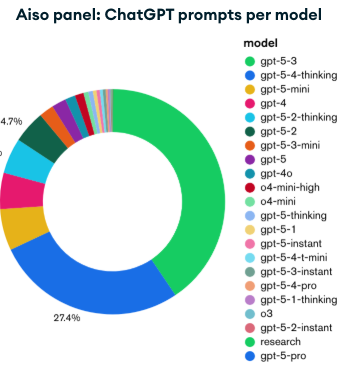
What the April 13, 2026 distribution looks like today:
gpt-5-3is the largest single slice at roughly 40% of answered prompts - the broad-distribution default, and it shows.gpt-5-4-thinkingis a clear second at roughly 28%. The 5.4 family is almost entirely Thinking; Pro and Thinking-mini are slivers.- After that, no single model is above ~6%. The next tier is the GPT-5.2 family (
gpt-5-2,gpt-5-2-thinking,gpt-5-2-instant) and the GPT-5 base family (gpt-5,gpt-5-mini,gpt-5-thinking), each around 5–6% of the donut. - GPT-4 (mostly
gpt-4o) holds on at about 4–5%. Not nothing, but clearly fading as a share. o4-mini-high,o4-mini, ando3together show up as a small reasoning-model wedge around 2%.- GPT-5.1 and GPT-4.5 are basically rounding error (well under 1% each) - itself a story: the 5.1 line never really took off in our panel, and 4.5 is essentially deprecated in usage even where it's still technically callable.
Shape of the distribution: two big slices (5.3 and 5.4-thinking) eating two-thirds of the donut, a middle band of 5.2 and the 5 base family, then a colorful long tail.
For a deeper methodology cut on how we classify and aggregate model usage, see our most popular ChatGPT models study.
Multi-Model Coverage: Beyond ChatGPT
While the bulk of this report focuses on ChatGPT - still the largest single platform in our panel - our collection now spans the three leading consumer-and-prosumer assistants. This matters for B2B prospects evaluating where to invest: branded mentions, recommendations, and citation patterns differ materially across providers.
Platforms Covered in Our Panel
10M+ unique IPs; coverage spans the current GPT-5.4 family (Thinking, Pro, mini, nano) and the still-supported GPT-5.3 line
Conversations across Gemini 2.x and 3.x families, captured via opt-in browser extension and partner integrations
Coverage across the Claude 4 family - Opus, Sonnet, and Haiku tiers
Cross-platform comparisons (e.g., share of brand mentions across ChatGPT vs. Gemini vs. Claude) are available on request for enterprise customers.
User Intent Patterns
Here's how conversation purposes break down across our panel:
Methodology Note
Intent labels were assigned by an LLM-based classifier (GPT-5.4 mini) over a stratified random sample of the panel, validated against a human-coded gold set with 91% agreement. Percentages below are weighted to the full panel. We publish percentages only; absolute prompt and conversation counts are kept private.
User Intent Distribution
AI Optimization & Assistant Use
57.3%Users seeking AI tools optimization, prompt engineering, and general assistant functions across various domains
Business & Marketing Analysis
16.8%Marketing strategy, business analysis, and commercial decision-making queries
Technical Development
9.4%Programming assistance, API integration, and technical optimization projects
Research & Information
7.2%Market research, competitive analysis, and information gathering
Content & Creative Work
5.9%Content creation, copywriting, and creative project assistance
Platform-Specific Queries
3.4%Questions about our platform features, premium model access, and optimization tools
AI optimization and assistant use cases dominate our panel at 57.3%, reflecting our platform's focus on helping users maximize AI tool effectiveness. The high proportion of business & marketing analysis (16.8%) and technical development (9.4%) queries demonstrates our user base's professional orientation. Platform-specific queries (3.4%) are unique to our service and wouldn't appear in general ChatGPT datasets, highlighting how our panel differs from broader user populations.
Industry & Vertical Breakdown
When we map commercially-oriented conversations (business analysis, technical development, research, and content categories above) to the industries the user or their target brand operates in, the panel skews toward technology and B2B software - which is why we publish vertical-level cuts for sales and category conversations.
Share of Commercial Conversations by Industry
SaaS, cloud, developer tools, enterprise software
Banking, investing, insurance, crypto, accounting
DTC brands, marketplaces, consumer goods
Agencies, content, advertising, publishing
Healthcare, pharma, fitness, mental health
Airlines, hotels, booking, tourism
Online learning, tutoring, academic research
Legal, real estate, manufacturing, non-profit, etc.
Industry tagging uses a hybrid classifier (zero-shot LLM + keyword rules) on entities mentioned in the conversation.
For B2B software prospects in particular: roughly 1 in 3 commercial conversations in our panel mention a SaaS, developer-tool, or enterprise-software brand - making this dataset particularly useful for category-level competitive analysis in tech.
Conversation Characteristics
Conversation flow analysis reveals patterns in how users structure their interactions with ChatGPT:
Conversation Characteristics
Quick Queries
Single-turn interactions for focused tasks
Extended Sessions
Multi-turn conversations for complex optimization
Deep Dives
Sessions with 10+ turns for thorough analysis
Premium Model Usage
Users preferring GPT-5.4 and other current-generation models
Our platform shows a strong preference for quick, focused interactions (62% single-turn), but with high engagement for complex optimization tasks (38% multi-turn sessions). The 8.7% deep dive rate for 10+ turn conversations reflects users working through detailed AI optimization challenges. Notably, 89% of our users prefer premium models (GPT-5.4 Thinking/Pro and GPT-5.3), demonstrating the value-conscious, performance-oriented nature of our panel compared to general ChatGPT usage patterns.
Platform and Timing Patterns
Usage patterns reveal interesting insights about when and how users access ChatGPT:
Weekly Usage Patterns
Device Preferences
Privacy and Data Processing
Data privacy and user protection were prioritized throughout the collection and analysis process:
Privacy Protection Measures
- ✓User Consent: Explicit agreement was obtained through a comprehensive consent mechanism before any data collection
- ✓PII Anonymization: Advanced anonymization techniques were applied to identify and remove personally identifiable information from all conversations
- ✓Content Filtering: Approximately 10% of collected conversations were filtered out, broken down as: NSFW / sexual content (~4.5%), suspected bot or scripted traffic (~3.0%), spam and prompt-injection probes (~1.5%), and abusive or harmful content (~1.0%)
- ✓Multilingual Processing: Privacy protection was applied across multiple languages including English, Spanish, German, French, and other European languages
- ✓Authentic Preservation: Spelling and typographical errors were preserved to maintain conversational authenticity
Panel Summary
Our conversation panel represents a specific segment of ChatGPT users - primarily technical, early adopters who actively seek out AI tools and optimization platforms. This gives us valuable insights into how this particular group interacts with ChatGPT.
The geographic and language concentrations reflect the communities where our platform gains traction - technical forums, AI optimization communities, and early adopter networks.
Why We Share This Data
Transparency about our data sources is important. When we publish insights about ChatGPT conversations, we want you to understand exactly what our panel looks like and how the data was collected. This context helps you better interpret our findings and analysis.
This demographic overview provides context for all our ChatGPT conversation insights and analysis. We believe in being transparent about our data collection methods and panel characteristics so you can better understand and interpret our findings.
Aiso Panel Snapshot - September 27, 2026
A one-pager you can share internally with your team or sales prospects.
Top Industries (commercial conversations)
- • Tech & B2B Software - 31.4%
- • Finance & Fintech - 14.2%
- • Retail & E-commerce - 12.8%
- • Media & Marketing - 11.6%
- • Health & Wellness - 9.3%
Top Geographies
- • United States - 10.0%
- • United Kingdom - 8.0%
- • Germany - 7.0%
- • France - 6.0%
- • Canada - 5.0%
Last updated September 27, 2026. Panel size current as of this date; demographic breakdowns shown above remain the Q1 2026 snapshot. Source: getaiso.com/blog/chatgpt_panel_data_demographics_blog_post
Explore More AI Usage Research
Discover additional insights about AI conversation patterns, model preferences, and emerging user behaviors.
Ben Tannenbaum
Founder of Aiso, specializing in AI conversation analysis and user behavior research. Focused on understanding demographic patterns in AI adoption and helping organizations navigate the evolving landscape of AI-powered interactions.
Learn more about Ben →