
In Aiso's opt-in panel for Q1 2026, the four GPT-5.4 variants accounted for roughly 78% of observed ChatGPT activity. GPT-5.3 Instant represented another 21%, leaving earlier-generation models at approximately 1% of the sample.
Data-Driven Insights
Our analysis is based on real ChatGPT query data collected through voluntary opt-in participation, while fully complying with privacy requirements. This gives us unique visibility into actual user preferences rather than speculation.
I haven't seen this type of data published elsewhere, and I thought it could be interesting to share with the community. The insights are readily available in our dataset, providing a rare glimpse into real-world ChatGPT model usage patterns.
Current Model Breakdown (Q1 2026)
Here's the breakdown of queries by ChatGPT model across our panel for the most recent quarter:
Model Share - Q1 2026
*Trailing 90-day window, last refreshed April 2026. Consistent with the panel breakdown in our demographics report.
Prompts per ChatGPT model
April 13, 2026 snapshot. The rollup above groups models into three buckets for readability; the donut below shows the full per-model breakdown. Distribution will keep shifting as OpenAI ships and retires models, so treat this as a point-in-time view.
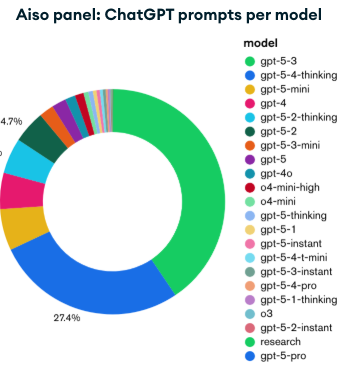
What the April 13, 2026 distribution looks like:
gpt-5-3leads at roughly 40% - the broad-distribution default.gpt-5-4-thinkingis a clear second at roughly 28%; Pro and Thinking-mini are slivers.- A middle band of the GPT-5.2 family and the GPT-5 base family (each model around 5–6%).
- GPT-4 (mostly
gpt-4o) holds on at about 4–5%. - A small reasoning-model wedge (
o4-mini-high,o4-mini,o3) around 2%. - GPT-5.1 and GPT-4.5 are rounding error (<1% each) - itself a signal that 5.1 never caught on and 4.5 is effectively retired in usage.
Key Findings
GPT-5.4 family
Leading Model
Thinking, Pro, mini, and nano variants together dominate panel usage and have replaced GPT-4o as the everyday workhorse
GPT-5.3 Instant
Strong Second
The faster, lower-latency option of choice - picked up most of the share previously held by GPT-4o mini and o3-mini
Earlier-generation (API-only)
Long Tail
GPT-4.5 and similar earlier-generation models remain available via API but represent only ~1% of conversations
What the Data Tells Us
GPT-5.4 leads as the new default - the four GPT-5.4 variants (Thinking, Pro, mini, nano) collectively serve as the workhorse for most users' daily interactions, having absorbed almost all of the share previously held by GPT-4o and the original GPT-5.
GPT-5.3 Instant holds the speed niche - coming in second, GPT-5.3 Instant retains meaningful adoption from users who care more about latency than the deepest reasoning. It has effectively replaced the role that GPT-4o mini and o3-mini played in early 2025.
Older models faded quickly after retirement - once OpenAI removed GPT-4o, GPT-4.1, o4-mini, and the original GPT-5 from ChatGPT in February 2026, their share in our panel collapsed within weeks. Earlier-generation API-only models now account for only about 1% of conversations.
What Users Actually Ask About ChatGPT Models
Usage share shows what models people end up on, but it doesn't answer the question they arrive with. The most common model-related prompts across Aiso's panel are comparison and recommendation queries: users want to know what changed between versions, and which one fits their specific workflow.
From Aiso's panel of millions of anonymized AI conversations
"Which is the best chatgpt model to use for plus users rightnow"
, ChatGPT Plus subscriber, June 2025
This is a Q1 2026 activity distribution, not a measure of which model users would freely choose. Default routing, plan access and product design can all affect usage. The data should guide testing of the sampled period, not be presented as the current model mix.
Reading the Share Data as a Recommendation
Based on the Q1 2026 panel distribution, the practical guidance breaks down simply:
- For most everyday tasks, the GPT-5.4 family (78% of panel activity): daily writing, Q&A, summaries, and coding. The flagship default for most Plus users.
- For complex, multi-step reasoning, GPT-5.4 Thinking specifically: users route there for research, analysis, and problems that require the model to work through steps before answering.
- For latency-sensitive applications, GPT-5.3 Instant (21%): developers and power users who feel the difference between a 1-second and 5-second response. Its share holds precisely because the use case is real.
Recorded activity is useful for describing this sample. It cannot isolate model preference from routing or availability. Monitor the model versions relevant to your customers and keep the period attached to every comparison.
Implications for Users and Developers
GPT-5.4 Family Dominance
The four GPT-5.4 variants together account for roughly 78% of ChatGPT activity in our panel - a clean handover from GPT-4o once OpenAI retired it in February 2026
GPT-5.3 Instant for Speed
GPT-5.3 Instant retains a strong ~21% share for users who prioritize lower latency over deeper reasoning
Old Models Faded Fast
Within weeks of GPT-4o, GPT-4.1, o4-mini, and the original GPT-5 being retired from ChatGPT, their usage in our panel collapsed to near zero
Quality Over Quantity
Users gravitate toward whichever model is currently OpenAI's flagship - early adopters stick with the newest frontier release rather than older cheaper options
The Power of Real Data
The analysis describes historical activity patterns. Explaining why those patterns occurred would require additional evidence about routing, access and deliberate user choice.
What's particularly interesting is how quickly users migrated when OpenAI retired the GPT-4o, GPT-4.1, and original GPT-5 lines - within weeks, almost the entire panel had moved onto the GPT-5.4 family, with GPT-5.3 Instant catching the latency-sensitive use cases.
What's Next?
More Data Breakdowns Coming
If this sort of data analysis is helpful to the community, we can provide more detailed breakdowns including usage patterns by time, geographic distribution, query types, and model performance comparisons.
We're committed to sharing insights that help the AI community better understand real-world usage patterns. This data can inform everything from product decisions to research priorities.
What other aspects of ChatGPT usage would you find valuable to explore? Let us know what data breakdowns would be most useful for your work or research.
Stay Updated on AI Usage Trends
Get access to more data-driven insights about AI model usage, search patterns, and brand visibility across ChatGPT and Gemini.
Ben Tannenbaum
Founder of Aiso, focused on AI search optimization and data-driven insights. Passionate about understanding how AI is changing search behavior and helping businesses adapt to this new landscape.
Learn more about Ben →