How to track your brand's visibility in AI search.
People now ask ChatGPT, Claude, Gemini and Perplexity full questions and trust the answer. This is the practitioner's playbook for measuring whether your brand shows up in those answers, the three methods that work, the metrics that matter, and how to track it all despite the fact that the same prompt gives a different answer every single time.
 Ben Tannenbaum
of AI recommendation lists repeat across 100 identical prompts - the variance problem in one number.
jump in ChatGPT-User crawl activity in a single month (Feb–Mar 2026) as AI browsing went mainstream.
distinct ways to measure visibility - and the best programs run all of them together.
AI search broke the metric you used to rely on
For twenty years, “visibility” meant one thing: your rank on a Google results page. It was a stable, repeatable number. Type the same query tomorrow and you saw roughly the same ten links.
AI search demolished that assumption. Ask ChatGPT “what's the best project management tool for a remote team of 15?” one hundred times and you get close to one hundred different ordered lists. The ranking is essentially random. What stays stable is the consideration set - the pool of brands eligible to appear at all. You can't reliably “rank #1” in AI. You can absolutely be present or absent from that pool, and if you're not measuring, you have no idea which one you are.
That single shift - from a deterministic rank to a probabilistic consideration set - is why the old SEO dashboard quietly stopped telling you the truth, and why measuring AI visibility takes a different toolkit.
Three ways to measure AI visibility
Each method answers a different question. Used alone, every one has a blind spot. Used together, they triangulate the full picture.
Prompt simulation
“When asked this question, does AI mention us?”
Send a fixed set of prompts to ChatGPT, Claude, Perplexity and Gemini on a schedule and score whether your brand is mentioned, cited or recommended. Great for competitive benchmarking, but every run is a single sample of a moving target.
- →Track the consideration set, not the rank
- →Run each prompt many times to average out noise
- →Tools: Profound, Peec, Otterly, Semrush AI Toolkit
Server log analysis
“How often is AI actually pulling from our site?”
Filter your access logs for AI user agents like ChatGPT-User, OAI-SearchBot and ClaudeBot. This is the only method built on real requests from real AI systems serving real users, with exact timestamps and the exact pages being cited.
- →Free - you already have the logs
- →Watch ChatGPT-User (it ignores robots.txt)
- →Correlate spikes with launches and press
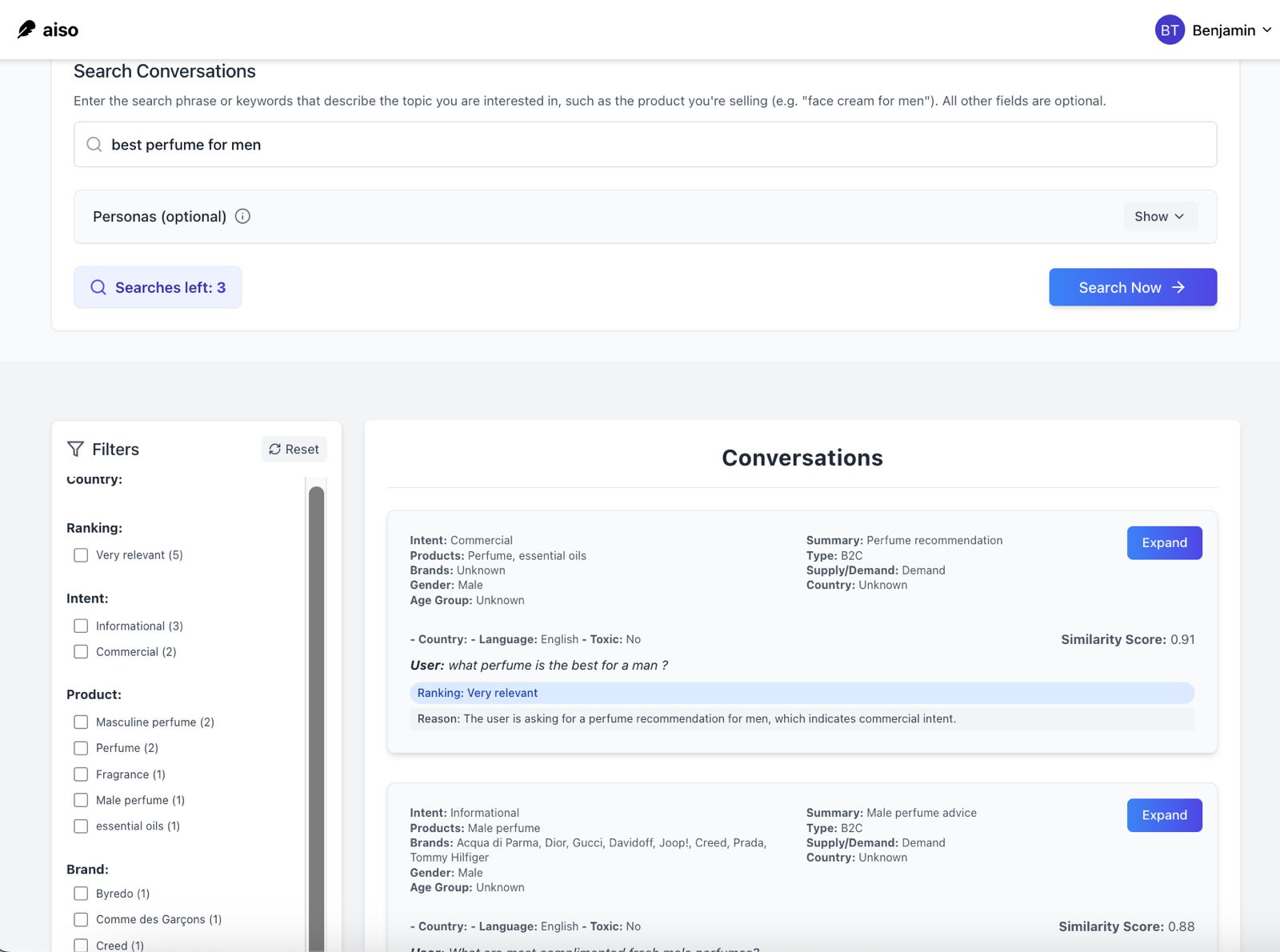
Real prompt intelligence
“What are real humans actually asking AI about us?”
Consent-based panels capture the actual prompts people type into AI. This is what reveals demand that no Google keyword list contains - the long, context-loaded questions that decide which brands get recommended.
- →Mirrors how people really phrase questions
- →Surfaces fan-out sub-queries behind each answer
- →Feeds both your tracking set and your content
The synthetic-prompt trap
Most tracking tools take your existing Google keywords, rephrase them as questions, and call it AI monitoring. When we compare those synthetic prompts against real prompts captured from a consent-based panel, they barely overlap. Here's the same buying intent, two ways:
Synthetic (from Google keywords)
- “best CRM software”
- “CRM for small business”
- “Salesforce alternatives”
Real (what people actually type)
- “We're a 12-person recruiting agency drowning in spreadsheets. What CRM tracks candidate relationships without costing Salesforce money?”
- “My team hates our CRM because the mobile app is terrible. Which one has the best mobile experience?”
The real prompts carry constraints - team size, budget, current tool, the specific feature that's the dealbreaker - and those constraints decide which brands get recommended. If your tracking set is built from keywords, you're measuring a question nobody is actually asking.
The six metrics that actually matter
Forget “rank.” In a probabilistic system you track rates and trends, not positions on a single day.
Presence rate
Across N runs of a prompt, the share where your brand appears at all. The single most stable, most actionable AI-visibility number.
Share of voice
Your mentions vs. each competitor inside the same answer set. Tells you whether you own the category or merely show up in it.
Citation rate
How often your own domain is linked as a source, separate from being named. A brand can be recommended without ever being cited, and vice versa.
Sentiment & accuracy
Is the AI describing you correctly and favourably? A confident-but-wrong answer is a visibility problem disguised as a presence win.
Bot crawl volume
ChatGPT-User and friends hitting your pages, by URL and day. The closest thing to a real impression count for AI search.
Answer position
First-named vs. buried in a list of ten. Order is noisy run-to-run, so trend it over weeks, never judge it on a single day.
See AI visibility tracking in action
A two-minute walkthrough of how Aiso surfaces the real prompts people ask AI about your category, and turns them into a visibility score you can act on.
A 4-step tracking program
- 1
Start with server logs (this week)
Filter your access logs for ChatGPT-User, OAI-SearchBot, ClaudeBot and PerplexityBot. It's free, it's ground truth, and it tells you exactly which pages AI is already pulling from.
- 2
Build a real prompt set (not a keyword list)
Source the questions people actually ask AI about your category from real conversation data, then add your highest-intent comparison and alternative prompts.
- 3
Sample, don't snapshot
Run each prompt many times across ChatGPT, Claude, Gemini and Perplexity. Report presence rate and share of voice as trends over weeks, never a single day's ranking.
- 4
Close the loop on content
Use what AI bots cite (logs) and what users actually ask (prompts) to decide what to publish next, then watch presence rate respond.
Frequently asked questions
Why does the same prompt give a different brand list every time?
Large language models sample their output, so a question asked 100 times produces close to 100 different ordered lists. What stays stable is the consideration set - the pool of brands eligible to appear. That is why you should measure presence rate over many runs rather than chasing a rank on any single day.
How often should I measure AI search visibility?
Run your prompt-simulation set daily so you have enough samples to average out the variance, but only report and act on weekly or monthly trends. Pair this with continuous server-log monitoring, which captures real AI bot visits the moment they happen.
Which platforms should I track first?
Start with ChatGPT, which holds the majority of consumer AI-assistant usage, then add Perplexity (search-heavy), Google's AI answers (huge reach), and Claude and Gemini. Weight your effort by where your specific audience actually asks questions.
Is server log analysis really better than a tracking tool?
They answer different questions. Logs tell you, with certainty, which of your pages AI systems are pulling from and how often - ground truth a simulator can't fake. Simulators tell you what AI says about your category and competitors, including brands that never touch your site. Mature programs run both.
Why not just reuse my Google keyword list as AI prompts?
People don't talk to AI the way they type into Google. A search of “best CRM” becomes a paragraph in ChatGPT, full of team size, budget, current tools and must-have integrations - constraints that change which brands get recommended. A tracking set built from Google keywords measures a question nobody is actually asking.
Written by
Ben Tannenbaum
Founder and CEO of Aiso, where the team analyses millions of real AI conversations to help brands understand and improve how they show up in ChatGPT, Claude and Gemini. Meet the team.
See what real users ask AI about your brand
Aiso turns millions of real AI conversations into a live picture of your visibility across ChatGPT, Claude and Gemini. Stop guessing which prompts to track. Start with the ones already happening.