
In the three-month Cloudflare snapshot reviewed for this article in June 2026, ChatGPT-User accounted for 47.4% of user-action bot requests to travel sites. TikTokSpider accounted for 50.4%. These are requests observed by Cloudflare, not people, recommendation impressions or a count of bookings. OpenAI describes ChatGPT-User as a user-action agent; a request does not tell you what appeared in the answer.
Not every OpenAI bot does the same job
OpenAI runs three separate crawlers, and conflating them is the most common mistake we see. Here's what each one does:
| Bot | What triggers it | What it signals |
|---|---|---|
| GPTBot | Scheduled, asynchronous crawling to gather training data | Your content may inform a future model. No connection to a live user. |
| OAI-SearchBot | Indexing for ChatGPT's search and citation features | Your page is eligible to be surfaced or cited inside ChatGPT search answers. |
| ChatGPT-User | Used for certain user-initiated actions that fetch a page | A user-action agent requested the page. This does not prove the prompt named your brand or the answer included it. |
ChatGPT-User is the one that matters for visibility tracking. It is not automated crawling. OpenAI describes it as user-triggered access tied to a specific request, not a scheduled sweep of the web. Cloudflare classifies this behavior as "user action" traffic, and it is the fastest-growing crawl purpose on the web, even though it is still a small slice of overall AI bot volume.
What the travel data actually shows
The snapshot used the Travel industry and User action filters. Its displayed shares were TikTokSpider 50.4%, ChatGPT-User 47.4%, Google-NotebookLM 0.8%, Meta-ExternalFetcher 0.6%, and Perplexity-User 0.5%. Preserve the date range and filter settings when comparing this historical view with the live dashboard. Rounded displayed values and omitted smaller categories need not sum to exactly 100%.
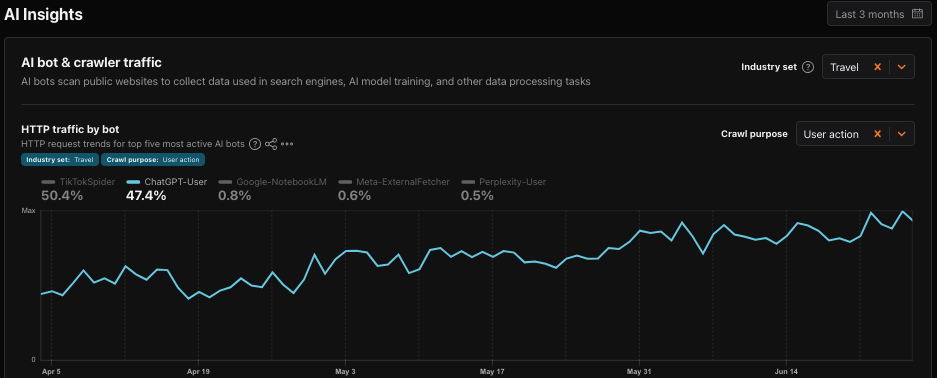
Cloudflare Radar, AI Insights, industry set: Travel, crawl purpose: User action, last 3 months.
This is a meaningful, free benchmark precisely because it isolates user-triggered visits from the training crawls that dominate raw AI bot traffic numbers elsewhere. If you only look at unfiltered AI bot traffic, training crawlers like GPTBot and Meta-ExternalAgent drown out everything else. Filtering to user action strips that noise out and leaves you with something close to: how often is a real person's ChatGPT conversation pulling up this industry's websites. Cloudflare published a deeper look at AI crawlers: breaking down traffic by purpose and industry with the underlying methodology.
The new industry filter, and why it widens the use case
Cloudflare added the industry filter specifically so site owners could compare themselves to a peer group instead of guessing. The available sets cover art, business and industry, computer and electronics, education, finance, gaming and gambling, health, internet and telecom, law and government, media and entertainment, news and publications, real estate, shopping and general merchandise, and travel. Whatever you sell, there is a curve for your category, and you can watch your own server logs against it.
If you run a hotel or a vacation rental, this is your benchmark
Direct bookings live or die on whether ChatGPT mentions your property by name and links to your own site instead of an OTA. The travel-filtered ChatGPT-User curve is the closest public signal you have for how often that is already happening across the category. Two practical moves:
- Check your own server logs for the ChatGPT-User string and see whether your share is tracking above or below the 47.4% baseline for travel.
- Make sure the pages ChatGPT fetches actually answer the question. ChatGPT-User requests are real-time and JavaScript-light, so pricing, availability, and policy details need to be in clean, crawlable HTML, not buried behind a booking widget.
The bigger picture
Cloudflare's own year-in-review data shows user-action crawling grew roughly 15x across 2025 even though it remains a small share of total AI bot traffic. Travel is one of the categories where that growth is most visible because trip planning is exactly the kind of multi-step, link-heavy question ChatGPT is built to browse for. As more of that research moves into a conversation instead of a search results page, server logs become a useful access diagnostic. They still do not establish whether a person saw a citation.
FAQ
Is ChatGPT-User traffic the same as a website visit from a person?
No. It shows up as a bot in your logs, but a real person's question is what caused it. It means ChatGPT fetched your page to answer someone, not that a human clicked through themselves.
Where do I see this data for free?
Cloudflare Radar's AI Insights page, at the "AI bot and crawler traffic" card. The industry and crawl purpose filters are free to use, no account required for the aggregate view.
Should I block GPTBot but allow ChatGPT-User?
That is a common configuration for sites that want to opt out of training data collection while staying visible in live ChatGPT answers. It is a separate decision from this benchmark, and worth making deliberately rather than by default.
How is this different from what Aiso tracks?
Cloudflare shows bot traffic at the server level, aggregated across an entire industry. Aiso shows the actual conversation, what was asked, which brands came up, and whether you or a competitor got the recommendation, at the level of a single brand rather than a whole category.