Research
ChatGPT's follow-up forms are another intelligent UI. Track your brand in conversations, not prompts
ChatGPT's new follow-up forms are another intelligent UI. Before it answers a commercial request, it asks the user for details in a form. The request the model answers is built across the conversation, so brands need to track their presence in conversations, not only in single prompts.

First published .
Bottom line
35.6%
median share of the user's conversation vocabulary found in the final prompt (670 commercial conversations)
50.3%
of commercial conversations had a request detail in earlier turns that the final prompt left out
26.1%
of conversations with a detectable request detail had a final prompt that carried all of them
Source: Tannenbaum, “The Prompt Is Not the Query”, arXiv 2607.22392, July 2026. 670 English commercial multi-turn conversations. The study measures what users wrote, not how history changes model answers.
Another intelligent UI
AI assistants keep adding interface around the chat box: product cards, maps, shopping carousels and now interactive forms. ChatGPT now systematically shows these forms when someone asks a commercial question. I asked for the best cold storage construction company in Texas. Before recommending anyone, ChatGPT showed a form headed “Let me narrow it down to the best fit”. It asked where in Texas the project was, with options for Houston and the Gulf Coast, Dallas to Fort Worth, Austin and San Antonio, or elsewhere. Then it asked about the type and size of the project.
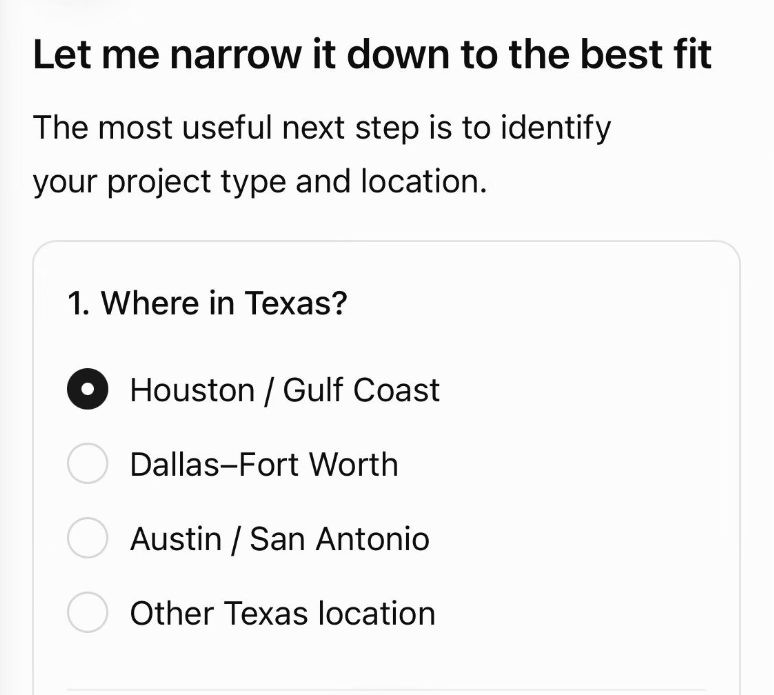
The form is very easy to use, so I expect people will use it. It saves them from writing a long prompt, and the answer fits their situation better. As they use it, and more of the request will live in the answers to those questions rather than in the first line they typed. I wrote about this first in a LinkedIn post on ChatGPT's new follow-up forms.
Each intelligent UI moves more of the request out of the prompt. For brands, that makes tracking answers to single prompts less accurate yet again, and tracking keywords even less so. Two people can type the same first line, fill in the form differently and get different recommendations. Your presence is decided in the conversation, so that is what you need to track. If you are a brand, the question is whether your measurement is ready for that.
What the research shows
We studied this in an earlier paper, published on arXiv in July 2026, The Prompt Is Not the Query: How Request State Evolves Across Multi-Turn AI Conversations. It measures how much of a user's request is visible in the last prompt they send, compared with everything they said in the conversation.
The study used 670 English commercial multi-turn conversations, split into a discovery set and a replication set. It checked the results against 7,463 public conversations from the PRISM dataset, written by 1,389 participants.
| Measure | Commercial (670) | PRISM (7,463) |
|---|---|---|
| Median vocabulary in final prompt | 35.6% | 36.4% |
| Final prompt holds half or less of the vocabulary | 68.4% | 74.3% |
| Earlier detail missing from final prompt | 50.3% | 44.8% |
| Final prompt carries every detected detail | 26.1% | 26.2% |
| Final prompt adds a new detail | 17.9% | 19.3% |
A request detail is a type of information the user gives, such as a constraint, a correction to an earlier assumption, a request for evidence or a reference back to options raised earlier. The paper detects these with fixed, transparent rules.
Half of commercial conversations had at least one such detail in earlier turns that the final prompt did not repeat. The final prompt carried every detected detail in only about a quarter of conversations. And in about one in five, the final prompt added something new. The last prompt is often a fresh update to the request, not a summary of it.
What the numbers do not show
Low vocabulary coverage mostly follows from turn length. Comparisons against length-matched baselines showed that short final prompts simply hold less information. That is the point for measurement: the information is spread across turns. It does not mean users drift off topic.
The study measures what users wrote. It does not estimate how much the earlier turns change the model's answer, or which brands it recommends.
What to do about it
- Track your presence across full conversations, including the answers people give in forms, not a single prompt per keyword.
- Write test prompts that include the details real buyers add later, such as project size, location, budget and must-have features.
- Make sure your own pages answer those details plainly, so a model can match you to the specific request, not only the category.
- Use real conversation data where you can. Our post on how search intent on ChatGPT differs from Google covers the same shift from another angle.