AI search · a working mental model
Which searches will move to AI?

First published .
The work people want to hand off
My working bet is that search shifts to AI most readily when the research is tedious, the next step does not depend on a conversation with a person, and answering properly means comparing information across many pages. Three questions help me separate those situations.
This is a mental model, not a measured adoption forecast. The examples below illustrate the reasoning. They are not a sample from Aiso's conversation dataset, and ten tabs is a memorable proxy for research effort, not a validated threshold.
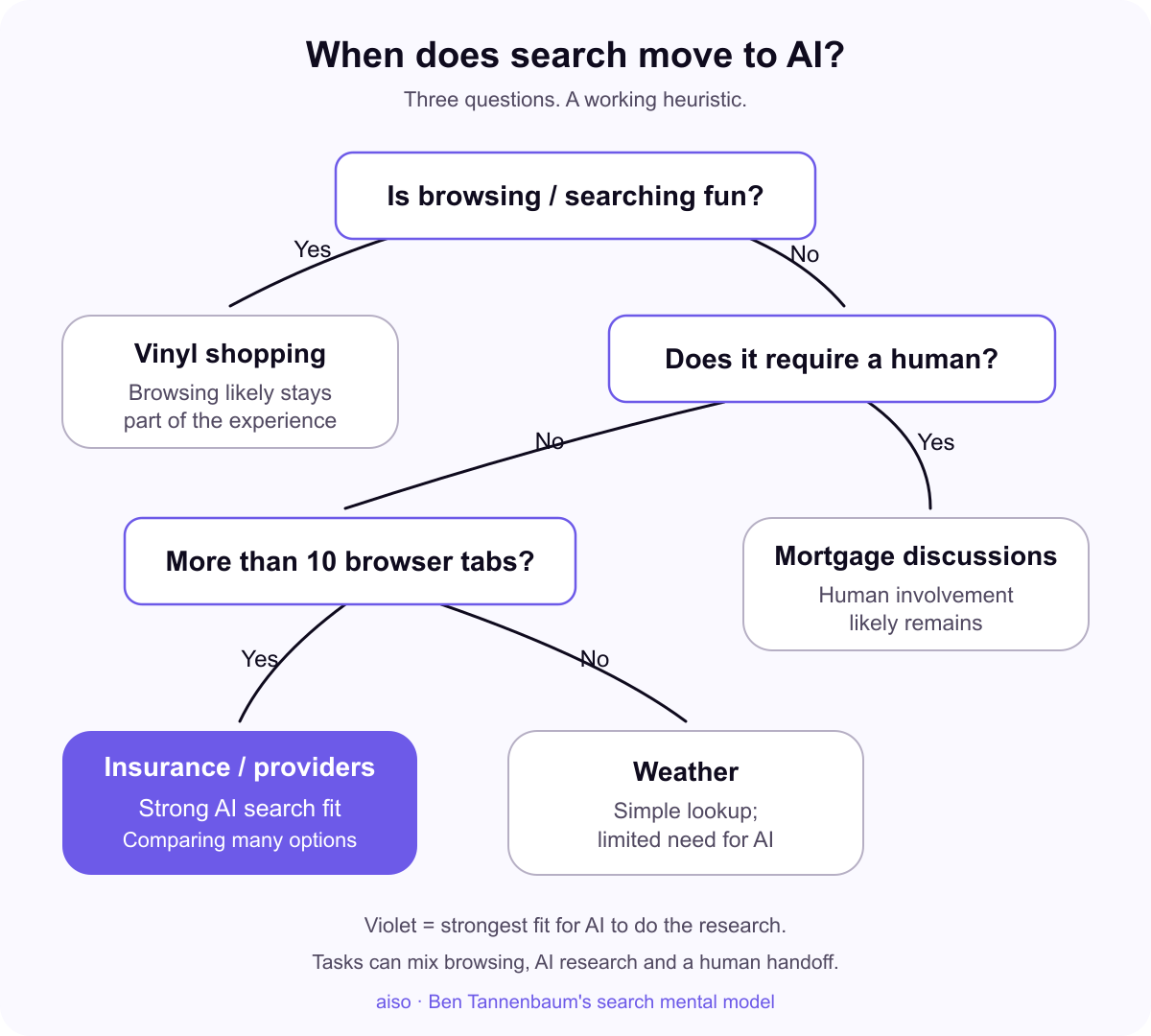
1. Is browsing or searching fun?
If yes, traditional browsing has a reason to survive beyond getting an answer. Vinyl shopping is an example. Looking through sleeves, stumbling on an unfamiliar artist and comparing editions can be the point of the activity. A perfectly efficient recommendation may remove something the shopper enjoys.
The same person might still ask AI to check whether a pressing is worth considering. Enjoyable discovery and tedious fact-checking can sit inside one purchase. The model predicts which part people are more likely to hand off, not which channel will own every step.
2. If it is not fun, does the task require a human?
Some tasks end in a relationship, an explanation or a negotiation. Mortgage discussions are a useful example: a person may want someone to explain the options, respond to their circumstances and discuss what can actually be offered.
AI can help prepare questions or organize information before that discussion. But a research summary and a human conversation do different jobs. When the value depends on another person's judgment or agreement, I am less convinced the whole journey moves into an assistant.
This branch is about the role of human involvement. It does not mean that every search related to a mortgage stays traditional, or that every task currently handled by a person must stay that way.
3. If no human is required, would it normally take more than ten tabs?
This is where my bet on AI search is strongest. Comparing insurance options or a long list of providers can mean finding the same facts on different sites, checking exclusions and keeping track of tradeoffs. The user wants a useful shortlist and the reasons behind it. Opening more pages is work.
An assistant can turn that scattered research into a conversation: what matters, which constraints are fixed, what rules an option out and what still needs checking. The useful output is a comparison that respects the person's requirements, with sources they can inspect.
AI does not remove the need to verify current terms, eligibility or the details of an offer. It can compress the research stage while the original provider remains the place to confirm what is available.
Ten tabs is shorthand for synthesis. Nine difficult pages may be a better AI task than twenty pages of enjoyable browsing. The underlying question is how much effort the user spends collecting, reconciling and comparing information.
What about a simple query like weather?
A straightforward weather lookup already has a short route to an answer. A search result, app or widget can resolve it with little effort. There is less work for AI to take over.
That is a weaker incentive to switch, not a claim that people will never ask an assistant about the weather. Put weather inside a more complex request, such as planning an outdoor weekend around rain, travel time and children, and the task changes. The assistant now has several constraints to combine.
Use the tree at the task level, not the industry level
A single purchase can travel through all three branches. Browsing records may be fun, checking editions may be tedious, and negotiating with a seller may need a person. Classifying the whole music market as either AI or traditional search would hide those differences.
For your brand, choose one customer task and write down:
- What does the person enjoy doing themselves?
- Where do they need a conversation with a person?
- Which facts do they have to gather from different pages?
- What must they verify before acting on the answer?
That gives you a more useful content brief than a broad prediction that your industry will move to AI. Make the comparison facts easy to find. Explain who your offer suits, where it does not fit and what the customer needs to check. Keep the route to a human clear where it matters.
Check the bet against real conversations
The tree helps decide where to look. Real conversations help test whether people are actually asking an assistant to do that work, how their requirements develop and which brands enter the shortlist.
Aiso's real-conversation and fan-out intelligence helps connect those customer questions with the searches an assistant makes behind an answer. Fan-outs are the smaller web searches an assistant may run while researching a broader request. Inspecting them can reveal which comparison facts and sources matter. An assistant does not search the web for every answer, and visible searches do not expose all of its reasoning.
For the next step, see how I would start AI-search work from zero and how to inspect fan-out queries. The goal is to test a specific customer decision, then improve the evidence that decision needs.
What this model can and cannot tell you
This is Ben Tannenbaum's qualitative assessment, published October 12, 2026. It proposes where delegation has a clear incentive. It does not estimate market share, predict a date for adoption or prove that AI recommendations are accurate.
Habit, convenience, trust, access to current information and the quality of the experience can all change the outcome. The useful prediction is narrower: when the user dislikes the research and has many facts to reconcile, there is a stronger reason to try AI.