Inside Aiso · September 2026
How we interview at Aiso: more candidates, better conversations

First published .
We changed our first interview so we can seriously consider more applicants without turning the people we do meet into a calendar problem.
Hiring has an annoying trade-off. If you review a lot of applications properly, the first-round calls eat the week. If you protect the calendar too aggressively, you end up filtering people on CV shortcuts before they ever get a chance to show how they think or communicate.
We are trying a different shape at Aiso. Think of it as a barbell: much more volume at the top, much more human attention at the qualified end.
Step 1: we review the application
We still start with the person's actual profile. CV, application, relevant work and the role all matter. The goal is not to have an AI rank a pile of names and decide who gets hired.
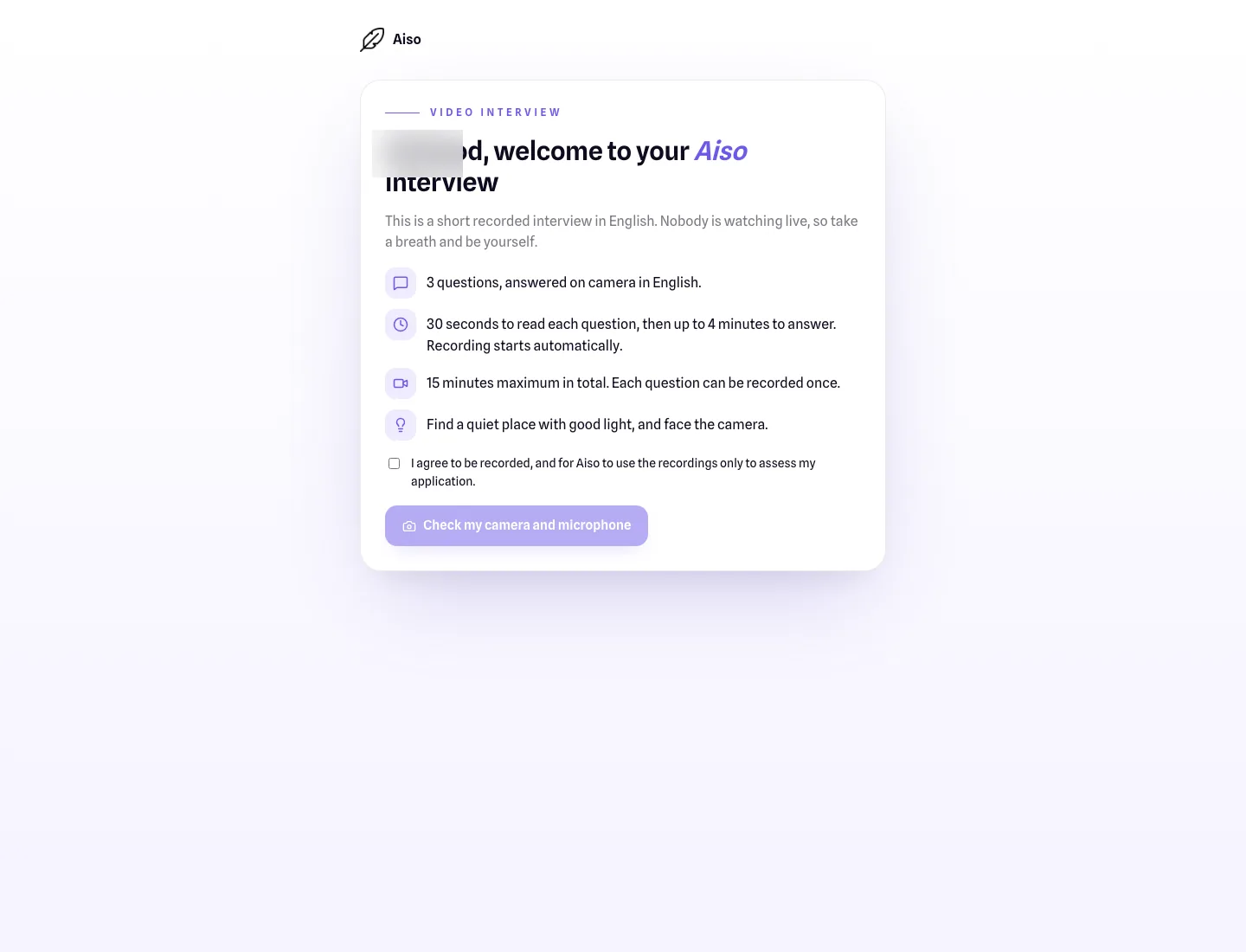
For candidates we want to hear from, we create a very short recorded first interview. The tool lets us set three questions, including questions based on what stood out in the application when that is useful.
Step 2: three questions, 15 minutes
The candidate gets a private link. There are three questions, 30 seconds to read each one and up to four minutes to answer. The whole thing is capped at 15 minutes. Nobody from Aiso is sitting on the other side of a Zoom call.
For client-facing roles we ask candidates to answer in English because spoken English is part of the job. For another role, the questions and what we evaluate can be different. The point is to test something the job actually needs, not to create a generic AI interview obstacle course.
Step 3: AI reviews the recording before we schedule a live interview
Once the recording is submitted, AI gives us a structured review of the answers. For the English screen, for example, it can assess fluency, grammar, vocabulary and coherence and provide a short explanation. That review is an input to our hiring process, not an automatic hiring decision.
We can then watch the recordings ourselves, look back at the application and decide whether a live conversation makes sense.
The important part is what happens to human time
The obvious way to describe this is “AI saves interview time.” That misses the part I care about.
Saving time on repetitive qualification means we can give more people a first shot. We do not have to be quite as brutal at the CV stage just because there are only so many half-hour slots in a week.
Then, when somebody gets to a live interview, we have more time for it. We already know the basics. We can talk about their work, challenge an idea, go deeper on something they built, and answer their questions about Aiso. The human interview becomes less about qualification and more about actually getting to know each other.
More automation at one end, more human attention at the other
That is the barbell. Automation expands the number of people we can evaluate. It also protects the scarce part of hiring: focused time between the team and a candidate who may actually join.
I would not use the system to make a final hiring decision. I also would not pretend an AI score is an objective measure of a person. The useful job for AI here is narrower: structure an early signal, make a high-volume step cheaper, and leave humans with more time for the decisions and conversations that deserve it.
By the way, we are hiring
We are currently hiring across consulting, sales, marketing, engineering and research. See the open roles on our Aiso careers page. If one fits, apply. There is a good chance you will see this interview flow yourself.