Aiso field guide
On-site content comes first. Then expand to third-party sources.

First published .
A practical order of work, with two caveats citation reports can miss.
Before chasing another mention, open the page a buyer would need on your own website. Can they work out what your product costs? Is the integration they need explained? Can they find evidence behind the claim you make on the homepage?
When those answers are missing, that is where I would start. On-site content comes first. Then expand to third-party sources.
This is an order of work, not a claim that your own website is all AI needs. Useful third-party coverage still matters, including through information paths a citation report does not show.
The next page may not be a blog post
A company can have a busy blog and still leave basic buying questions unanswered. A page about industry trends does not tell a buyer whether a plan includes the feature they need. A long introduction does not replace the conditions attached to a price.
Take the question: “Will this work with our existing setup?” A useful page might explain supported integrations, what has to be configured and which limitations remain. That is more helpful than another paragraph claiming the product is flexible.
For a location-based business, the missing page might describe access outside office hours. For a service business, it might explain who the service is suitable for and what the first month involves. These are illustrative examples, not client outcomes.
Start with an actual buyer question. Put the current page beside it. Highlight the facts a reader would still have to ask you for. Those gaps are a more useful brief than a target word count.
A specific-site search needs a specific answer
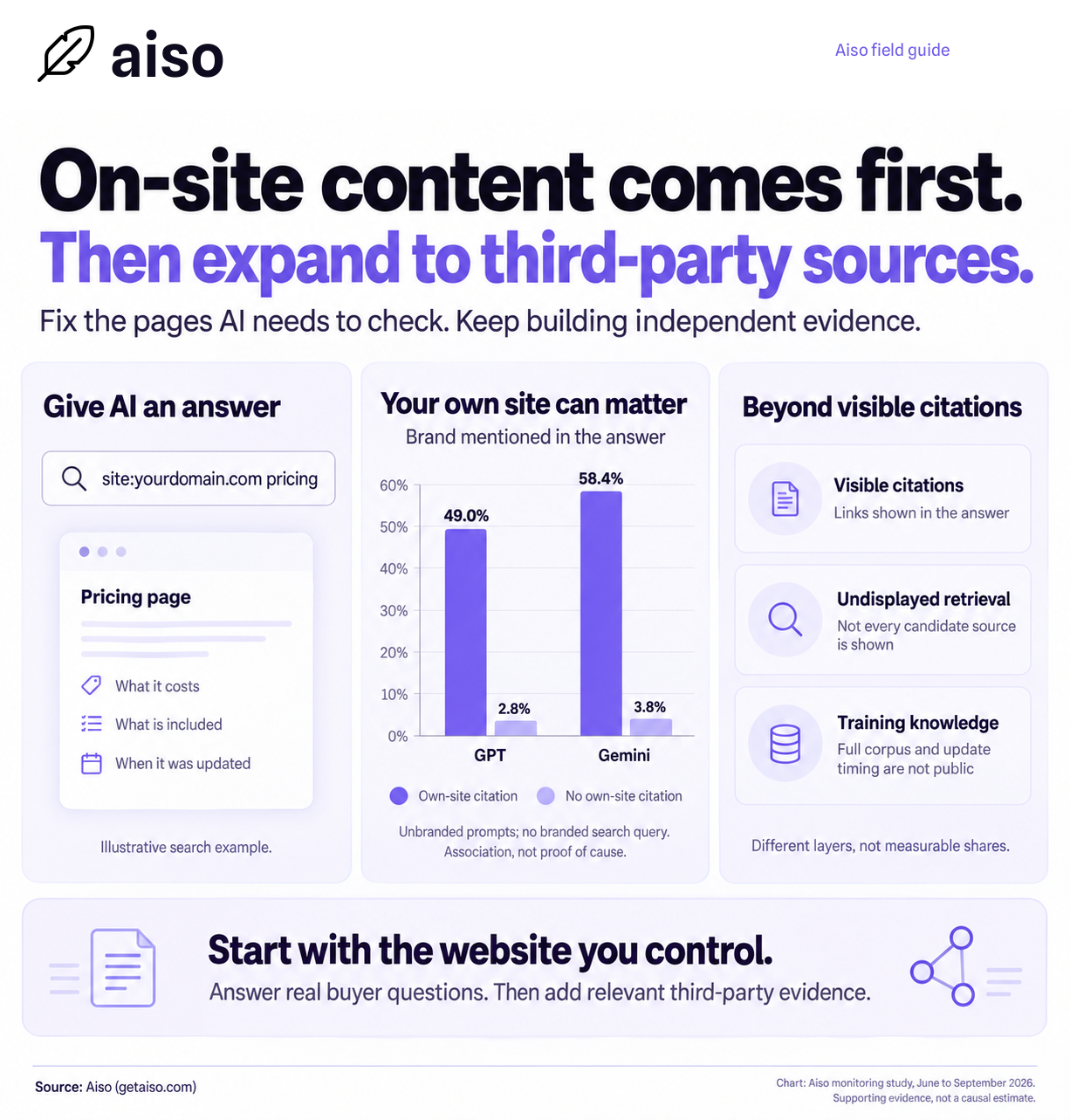
A search such as site:yourdomain.com pricing restricts results to your domain. If an assistant uses that query while checking a candidate, the relevant information needs to be available there.
The search box in the infographic is an example, not a measured trend. It does not mean every assistant runs a domain-restricted search or that we can infer an industry-wide increase from this illustration. Our guide to query fan-outs explains why the searches behind an answer can differ from the question a person typed.
The practical implication does not depend on a particular percentage. If an assistant or a human checks your website, give them something they can verify. State the price conditions. Name the supported integration. Include a dated example whose result is explained rather than implied.
Where the Aiso chart fits
The centre panel uses Aiso's monitoring research. In the unbranded-prompt groups with no branded search query, GPT mentioned the target brand in 49.0% of answers with an own-site citation and 2.8% without one. The equivalent Gemini rates were 58.4% and 3.8%.
The study contained 34,960 GPT and Gemini monitoring observations across 75 projects from June to September 2026. The chart compares subsets of that panel, not independent real-buyer conversations. Citations and mentions can arise together. These are associations, not causal lift, positive recommendations or purchases. The manuscript, Table 3, provides the counts and methods.
We covered the measurement in more detail in our earlier article on useful website evidence. Here the question is what to do next, rather than how to turn that association into a promise.
The first caveat: citations are not a complete retrieval log
A citation is a link displayed with the answer. It is not an inventory of every query issued, every candidate returned or every page considered. Some retrieval work may not be exposed in the interface. A URL appearing in retrieval data also does not establish that its entire page was opened and read.
That makes a citation decline hard to interpret on its own. A third-party source can disappear from the displayed links without proving it had no role in the answer. Equally, finding a matching phrase on a page does not prove the assistant retrieved that exact page. It could have encountered another copy or learned similar wording earlier.
Our investigation into ChatGPT's sources discusses that limit. For a stronger diagnosis, keep the actual answer, the visible source list and any available search metadata together. Be explicit about what was observed and what remains unknown.
Training is the other missing piece
Live retrieval is not the only route by which information can affect an answer. Information may also have been learned during training. A third-party review or article could matter through that route even when it is not cited in a particular response.
We cannot inspect a complete proprietary training corpus or its full refresh schedule. Recent-looking knowledge without a visible search is not proof that training was updated yesterday. The answer could reflect retrieval that was not displayed, supplied context or another explanation.
Aiso's guide to testing brand recognition without search explains why such tests are useful diagnostics rather than a definitive audit of model weights. Do not assign percentages to the contribution of training versus hidden retrieval. The infographic deliberately shows separate layers, not measured shares.
Then build the outside evidence
Once a useful page exists, look for the places where independent evidence belongs. An accurate directory entry can confirm a location. A detailed review can describe an experience your own copy cannot independently validate. A relevant publication can explain why a result matters to its readers.
Choose those sources because they help the buyer and the evidence, not just because a chart once showed a large citation share for that domain. Keep third-party work that already brings you customers. Improving your site is not a reason to turn it off.
For the next content brief, I would write down the buyer's question, the page that should answer it and the missing proof. Fix the page, then identify where outside corroboration would help. Review the same requests again after the changes without treating one answer as a permanent ranking.
At Aiso, we use real buyer questions and the searches behind them to work out what good content means for a particular business. The output should be a page you can improve and a reason to improve it, not an instruction to publish more of everything.
About this guide
Source: Aiso (getaiso.com). This is a practical interpretation supported by Aiso research, not a new experiment. The search example and information-layer diagram are explanatory. The numerical chart uses the monitoring study linked above. No new site-search growth rate or hidden-source contribution estimate is claimed.
Watch the short guide
The complete short Substack edition, generated with Substack AI voiceover and finished with Aiso's colors and logo.
Watch on Aiso's YouTube channel or read the short Substack edition.
Read the LinkedIn article or join the discussion on the infographic post.