Aiso Research · 2027 outlook · evidence published in 2026
7 AI search predictions for 2027, backed by real conversation data

First published .
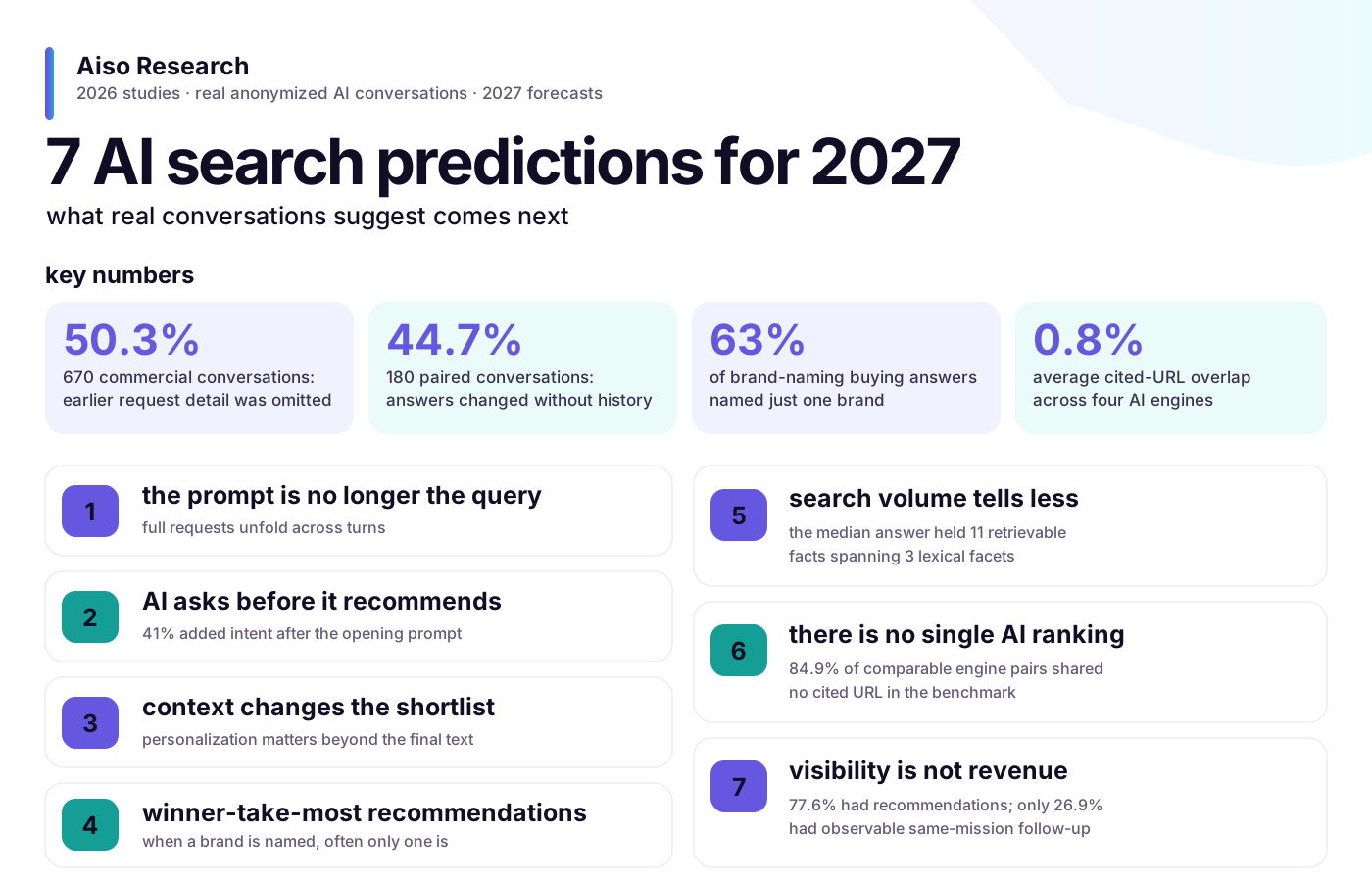
Aiso studies real, anonymized AI-human conversations. Our 2026 papers have examined what a prompt leaves out, how history changes an answer, which sources AI engines cite and what follows a product recommendation. Here are seven bets for 2027, with the actual numbers and the limits of each study.
These forecasts bring together separate Aiso studies from 2026, each examining a different part of the AI search journey.
Key numbers
50.3%
of 670 commercial conversations left an earlier request detail out of the final prompt
The Prompt Is Not the Query
44.7%
of paired answers differed materially after removing conversation history
Beyond the Final Prompt, 180 pairs
63%
of brand-naming buying-intent answers named just one brand
Aiso buying-intent panel
0.8%
mean exact-URL citation overlap between AI engines on the same prompts
Four-engine benchmark, 15 prompts
Most AI search dashboards still look as though we are measuring a new kind of search-results page. They take one question, run it through a model, record the brands and links, and move on. That helps with monitoring, but real buyers often spend several turns clarifying what they need.
People change their minds mid-conversation. They introduce requirements in the fifth turn. The model asks for clarification or looks up sources that were never mentioned in the prompt. And after a recommendation, we often cannot see what happened next. These are the gaps behind our predictions.
The prompt stops being the unit of search
A buyer might spend twenty minutes describing a product, narrowing the budget and ruling out a few options, then finish with: “Which would you pick?” Measuring that last sentence as a standalone query misses the actual request.
In our study of 670 English commercial multi-turn conversations, the final prompt contained a median 35.6% of the vocabulary used across the session. In 50.3% of conversations, an observable request detail appeared earlier but did not appear again in that final prompt. The independent PRISM comparison of 7,463 conversations showed 44.8% on the same missing-detail measure.
My prediction: by the end of 2027, serious AI-search measurement will track the entire conversation and how the buyer's requirements develop. That means capturing earlier constraints, brands considered and options the user rejected.
AI asks more before it recommends
The opening question often lacks the detail needed for a useful commercial recommendation. In the same 670-conversation cohort, 41.0% added at least one detectable intent dimension after the opening prompt. The public PRISM cohort showed 41.7%. Buyers reveal what matters as the conversation unfolds.
We are already seeing assistants present follow-up questions as structured forms and selectable options. I expect more of that in 2027, particularly when price, location, use case or exclusions determine the right product. A coworking request can quickly become a discussion about desk count, commute, opening hours and budget. The brand shortlist comes after those answers.
The marketing consequence is practical: if you are only visible for the initial broad prompt, you may still disappear when the user specifies the requirements that actually drive selection.
Conversation context becomes part of the ranking
We also tested whether history merely changes the wording of a request or changes the answer itself. In 180 paired conversations, we compared the assistant's response with the full conversation against its response to the final prompt alone.
The two answers differed materially in a weighted 44.7% of cases, with a 95% confidence interval of 33.8% to 56.1%. Conversation history changed the substance of the answers.
In 2027 I expect personal context to play an even larger role in recommendations. Two buyers can type the same final sentence and receive different shortlists because one previously mentioned a budget, an existing supplier or a dietary restriction. A static ranking screenshot will not reliably reproduce either journey.
Recommendations become winner-take-most
Our buying-intent panel exposes a peculiar gap. Around two-thirds of selected buying questions received no named brand at all. Among the answers that did name a brand, 63% named only one. Nearly nine in ten named three or fewer.
Traditional search can spread attention across a page of competing links. An assistant may give one brand the whole recommendation. The first challenge is getting considered and named. The winner can change across different buyer contexts and model runs.
My bet for 2027 is that marketing teams will spend less time asking “What position do we rank?” and more time asking “In which buyer journeys do we get named at all?” They will also need to distinguish a passing mention from a genuine recommendation.
Search volume becomes less useful on its own
An AI answer can resolve a surprisingly large amount of research at once. Across 183 information-seeking conversations, containing 1,994 retained answer units, our search-density study found a median 11 retrievable units per answer. A median three lexical facets covered 80% of those units.
The 11 units capture retrievable facts within an answer; the three facets come from a method for reconstructing its information needs. In a separate six-case live-web pilot, reconstructing 80% of an answer took a median 1.5 queries and two source pages.
By 2027, counting prompts will look increasingly thin beside measuring the questions and factual requirements an answer satisfies. One conversation about choosing software can cover pricing, integrations, security and support, with no distinct search volume for each fact.
There is no single AI ranking
We submitted the same 15 prompts to four live AI search engines and examined 589 cited URLs. In the June 6 snapshot, mean exact-URL overlap across comparable same-prompt engine pairs was just 0.8%. In 84.9% of those comparisons, the engines shared no cited URL. Across 60 comparisons where all four engines were present, none shared a top-five URL.
The benchmark used 15 prompts from one commercial category over a short period. Even with the same visible question, the four engines selected markedly different sources.
In 2027, a score that claims to represent 'AI search ranking' across engines will need a lot more explanation. Source exposure, citation and brand recommendation are separate events. A brand can be recognized in an answer without its own website being cited, and a cited page does not necessarily mean the brand was recommended.
Watch the four-engine citation experiment
A 44-second look at what happened when we asked four AI engines the same questions and compared the sources they cited.
Visibility gets easier to measure than revenue
A brand recommendation can be counted in an answer. A completed buying decision is much harder to observe. Our purchase-advice paper screened 317 historical interactions and retained 67 purchase-directed episodes. Of those 67, 52 (77.6%) contained a commercially meaningful recommendation. Only 18 (26.9%) contained a later user message continuing the same buying mission.
The 26.9% measures visible follow-ups in the conversation. Buyers may also leave the chat to visit a website, call someone, purchase offline or continue their research elsewhere. Those later actions require separate attribution data.
In 2027, more dashboards will give brands visibility, citations and sentiment. Fewer will be able to make a defensible claim about incremental sales. The good systems will join answer-level evidence to referrals, lead capture and eventual outcomes, while clearly marking the gaps.
The full numbers and where they came from
Each study uses its own sample, definitions and methods. The table keeps the denominators alongside the findings.
| Study | Sample | Observed finding |
|---|---|---|
| Prompt history in commercial conversations | 670 conversations | 50.3% omitted an earlier requirement from the last prompt; median final-prompt vocabulary coverage was 35.6%. |
| Public replication | 7,463 PRISM conversations | 44.8% omitted an earlier need; median final-prompt vocabulary coverage was 36.4%. |
| Developing intent | 670 commercial conversations | 41.0% added a detectable intent dimension after the first prompt; the PRISM comparison was 41.7%. |
| Context removal experiment | 180 paired conversations | 44.7% materially different answers, weighted; 95% CI 33.8% to 56.1%. |
| Answer-reconstruction density | 183 conversations, 1,994 answer units | Median 11 retrievable units per answer, with 3 lexical facets covering 80% of them. |
| Buying-intent panel | Tens of thousands of selected conversations | About 66% named no brand; among brand-naming answers 63% named one, and nearly 90% named at most three. |
| Cross-engine citations | 15 prompts, four engines, 589 citations | 0.8% mean exact-URL overlap; 84.9% of comparable engine pairs shared no URL. |
| Purchase advice | 317 screened; 67 retained episodes | 52/67 (77.6%) contained recommendations; 18/67 (26.9%) showed a same-mission follow-up. |
How I would measure AI search in 2027
For a brand, I would start with the actual commercial questions people ask, then map the rest of the conversation around them. Which requirements narrow the options? Which brands make it into the answer? Which sources are cited, and which are simply not visible? Repeat those checks across engines and over time.
Then I would keep a separate outcome layer. That includes AI referrals where they can be observed, consent-permitting campaign attribution, qualified leads, bookings and sales. Keep the sales outcomes alongside the visibility metrics so you can see where an AI recommendation connects to a real customer action. Our AI-search revenue measurement guide explains the distinction.
For content, the work is concrete. Publish the comparison facts a buyer needs, make them easy to verify on your own website, and find credible third-party evidence where it belongs. Our site-evidence study and query fan-out guide are useful starting points. Different AI engines may retrieve different pages for the same question, so monitor the sources rather than assuming one good page will win everywhere.
Methodology and limits
These predictions were written on 19 November 2026 using Aiso's previously published research and its consent-based, de-identified conversation research. The commercial, PRISM, information-seeking, paired-experiment and purchase-advice samples address different research questions. The cross-engine citation audit covers 15 prompts in one commercial category.
The 41% figure tracks new intent dimensions appearing after the first turn. The 44.7% captures material answer differences in a paired context-removal experiment. The 11 units are retrievable facts identified through answer reconstruction. The 63% describes selected buying-intent answers that named a brand, and the 26.9% tracks observable same-mission follow-ups. Each measure has a distinct sample and denominator.
The underlying papers and detailed write-ups are collected on Aiso Research. The most important thing they reveal is what traditional prompt- and rank-based measurement leaves out. How quickly products and marketers adapt in 2027 remains the forecast.